

Modern automated manufacturing demands faster production cycles without sacrificing accuracy, reliability, or equipment life. As manufacturers look for ways to increase throughput and reduce cycle times, traditional precision conveyor designs can encounter mechanical limitations when operating at increasingly higher speeds.
The LFA HSP Series High-Speed Precision Link Conveyor was developed to address these challenges. Based on the proven LFA precision link conveyor platform, the LFA HSP incorporates a redesigned conveyor geometry, optimized motion profiles, and dual-motor capabilities to significantly reduce indexing times while maintaining precise, controlled motion.
The result is a precision transfer system designed for high-speed automated manufacturing applications where both speed and positioning performance are critical.
A precision link conveyor consists of rigid links connected in a continuous loop and driven around straight and curved sections of the conveyor.
At moderate operating speeds, traditional conveyor geometry provides reliable and precise motion. As conveyor velocity increases, however, the transition between straight and curved sections becomes increasingly important.
When a conveyor link enters a traditional circular turn, radial force is introduced. This force increases with the square of velocity, meaning that relatively small increases in conveyor speed can create significantly larger dynamic forces.
With conventional geometry, the transition from a straight section into a circular turn can create a sudden change in radial force. At high speeds, that abrupt transition can increase mechanical stress, vibration, and component wear.
Simply increasing motor speed is therefore not an effective way to create a reliable high-speed precision conveyor.
The conveyor geometry itself must be optimized for high-speed motion.
To overcome this limitation, the LFA HSP uses a specially developed mathematical transition curve between the straight and curved portions of the conveyor.
Instead of allowing radial force to appear abruptly as the conveyor enters a turn, the redesigned geometry allows that force to build progressively.
This creates a smoother transition through the curved sections of the conveyor and reduces the mechanical disruption that can occur at higher operating speeds.
The design also changes how the conveyor’s ball bearings transition out of the drive sprocket. Rather than remaining engaged until the link reaches the straight section, the bearings begin leaving the sprocket earlier and transition smoothly onto the optimized curve.
This controlled transition allows the conveyor to operate at significantly higher speeds while managing the dynamic forces acting on the system.
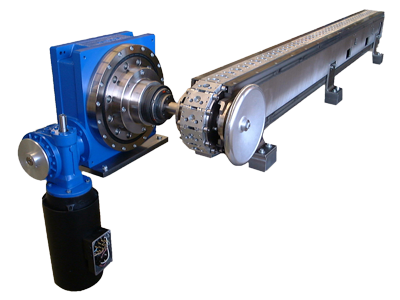
The LFA HSP’s symmetrical design also allows the conveyor to be driven from both sides using two synchronized servo motors.
Using two motors distributes the power required during acceleration instead of relying on a single drive.
During testing, Motion Index Drives and its engineering partners were able to coordinate the motors so that approximately 58% of the acceleration power was supplied by one motor and 42% by the second.
Proper synchronization is critical. The motors must work together without compromising the positioning performance of the conveyor.
By distributing acceleration forces between two motors, the LFA HSP can further reduce indexing time while maintaining controlled, precise motion.
The LFA HSP was tested using two coupled servo motors with total loads of up to 200 kg distributed across the conveyor links.
Testing was performed in both horizontal and vertical conveyor orientations. Different feed lengths were evaluated while acceleration and deceleration profiles were optimized to determine the minimum achievable indexing times.
The testing produced the following results:
| Feed Length | Measured Indexing Time |
|---|---|
| 150 mm | 203 ms |
| 300 mm | 268 ms |
| 450 mm | 328 ms |
| 600 mm | 382 ms |
| 750 mm | 443 ms |
| 900 mm | 499 ms |
| 1,050 mm | 558 ms |
| 1,200 mm | 625 ms |
| 1,350 mm | 682 ms |
| 1,500 mm | 738 ms |
These results demonstrate the ability of the LFA HSP to perform relatively long indexing movements in fractions of a second, even when carrying substantial distributed loads.
Testing also showed that minimum indexing time is ultimately influenced by available motor torque, making proper motor sizing and motion-profile optimization important when configuring a high-speed transfer system.
Maximum speed alone does not determine the performance of a precision conveyor.
Payload, feed length, acceleration, deceleration, motor torque, conveyor orientation, and required cycle time all influence the ideal motion profile.
For this reason, the LFA HSP can be configured with a velocity profile optimized around the requirements of the individual application.
This allows manufacturers to balance:
Optimizing these factors can help increase throughput while reducing unnecessary energy use and mechanical stress.
LFA precision link conveyors can be configured in multiple layouts depending on the manufacturing process.
Common configurations include linear systems with two U-turns and rectangular conveyor layouts with four 90-degree turns. Custom geometries can also be engineered for applications requiring a specialized footprint or production layout.
The system can operate using either intermittent start-stop indexing or continuous motion, allowing the conveyor architecture to be adapted to different automated processes.
The combination of high-speed motion, precision positioning, and configurable conveyor geometry makes the LFA HSP suitable for a wide range of automated manufacturing processes.
Potential applications include:
For manufacturers where fractions of a second have a meaningful impact on overall production output, reducing conveyor indexing time can significantly increase the number of parts produced over the life of the equipment.
Increasing the speed of an automated transfer system involves more than installing a larger motor or increasing conveyor velocity.
At high speeds, the geometry of the conveyor, dynamic forces through curved sections, motor synchronization, payload, and acceleration profile all become critical engineering considerations.
The LFA HSP High-Speed Precision Link Conveyor addresses these challenges through optimized transition geometry, synchronized servo drives, application-specific motion profiles, and the proven precision link conveyor platform.
For manufacturers looking to reduce cycle times while maintaining precise and controlled part movement, the LFA HSP provides a high-speed transfer solution engineered around the physics of the application.