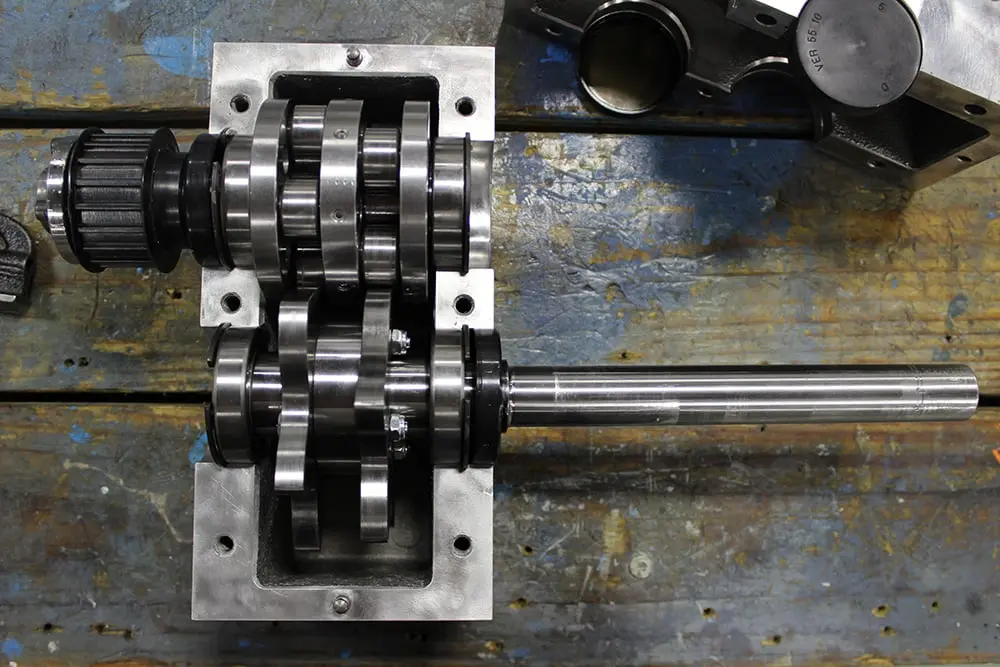
Rotary index table cost depends heavily on the motion, controls, load and flexibility an application requires. While some automated systems need servo-programmable positioning, many applications only require a fixed, repeatable index—such as a 90° or 180° rotation.
Motion Index Drives engineers fixed mechanical rotary index tables that can provide a more cost-effective solution without sacrificing the precision, durability and reliability required for industrial production. By matching the indexing technology to the actual application requirements, manufacturers can avoid paying for servo controls, programming and functionality they don’t need.
If your application does not require infinitely programmable, on-the-fly variable indexing profiles (e.g., you just need a reliable, fixed 90-degree or 180-degree intermittent motion index), opting for a Fixed Series mechanical cam indexer can offer a simpler and economical approach.
Lower Control Costs: AC Motor and VFD vs. Servo: A fixed rotary index table can be operated with a standard AC brake motor and a simple open-loop VFD or motor starter. This lowers costs that come with a servo motor and absolute encoders.
Lower Engineering Costs with Standard Rotary Index Tables: Selecting a fixed rotary index table from our catalog provides proven mechanical performance without adding the cost of heavy-customization components.
Reduced Long-Term Maintenance Costs: Motion Index Drives fixed rotary index tables are self-lubricated and sealed for life, helping reduce maintenance costs and repairs due to downtime.

We had a customer that was using only a gear reducer, with servo motor and servo controller. They thought they could save money by going to servo controls without an indexing drive, but the costs to buy all of the controls to do a simple, 90 degree rotation turned out to be very high. The customer came to us for a cost effective solution.
We provided them with a RTX650/4 rotary indexing table, with 3 phase AC gearmotor, that could be run on a simple, cost effective open loop VFD. The positioning is fixed, reliable, and mechanically robust to provided a fixed, 90 degree rotation with no programming or expensive controls commissioning.
In addition, the solution has a built in bearing for the headstock, to further reducer mechanical cost and build time. The motor had connector plugs installed for simple plug and play operation, as well as a manual handwheel on the motor, for manual rotation of the tooling when power is not available. This was something that was not an option or possible with a servo reducer. The result: over 40 units are being converted to this cost effective, reliable, mechanical solution.
| Cost Consideration | Fixed Mechanical Indexing | Servo-Programmable Indexing |
|---|---|---|
| Motor/controls | AC motor + VFD possible | Servo motor + servo drive |
| Positioning | Mechanically fixed | Programmable |
| Programming | Minimal | Required |
| Controls complexity | Lower | Higher |
| Variable index angles | No | Yes |
| Best cost fit | Repetitive fixed indexing | Applications requiring flexible positioning |
How much does a rotary index table cost?
The cost of a rotary index table depends on factors such as table size, load, number of index positions, cycle time, motor and controls, tooling requirements and whether programmable positioning is required.
Is a fixed rotary index table less expensive than a servo indexer?
For applications requiring only fixed positions, a mechanical cam-driven index table can reduce controls and integration costs because it can operate with an AC motor and VFD rather than a complete servo control system.
When should I use a servo rotary index table?
Servo-programmable indexing is better suited for applications requiring variable positioning, multiple programmable index angles, flexible motion profiles or process changes.
Can a lower-cost rotary index table still provide high precision?
Yes. Cost can often be reduced by eliminating unnecessary control complexity rather than compromising the mechanical precision or durability of the indexing system.
Find the Most Cost-Effective Rotary Index Table for Your Application
Choosing the lowest-cost rotary table isn’t about selecting the least expensive component. The goal is to avoid paying for motion capabilities, controls and customization your application doesn’t require.
Contact Motion Index Drives with your application requirements, including:
- Required number of stops or index angle
- Approximate tooling/load weight and diameter
- Required cycle time
- Whether variable positioning is required
- Whether an AC motor/VFD or servo system is preferred
Motion Index Drives engineers can determine if a standard fixed rotary index table or servo indexing solution can provide a balance of mechanical performance and cost.