When to Choose a Cam-Driven Rotary Indexer
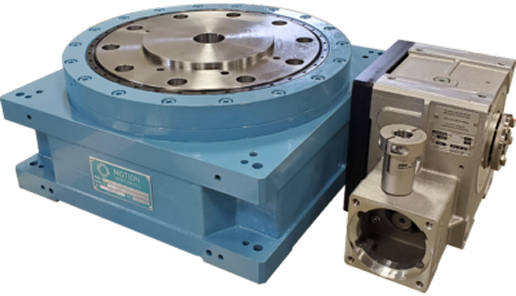
Cam driven rotary tables or commonly referred to as fixed cam indexers are extremely reliable. They can run for decades without issues or losing positions or needing to be re-homed.
If the process never has to change by adding stations the cam driven rotary table is a much better solution for applications under 10 feet in diameter. For applications that are under 10 feet in diameter, the cost of integration is much lower than servo rotary.
Reasons for lower cost of integration:
- Cam driven rotary tables utilize AC motor and can be operated with simple low cost VFDs and in some cases contactors.
- Commissioning time is greatly reduced due to positions are mechanical located with the internal cam of the rotary table.
- When utilizing a Motion Index Drives cam driven rotary table there is zero backlash in position as the cam/cam follower mechanism is in a preloaded state, essentially locking the top dial in position without any lateral movement.
Limitations to cam-driven rotary tables
- They have a fixed degree of output that cannot be changed or altered once the rotary table is manufactured.
- Applications that are 10 feet or more in diameter can get more costly to use a cam driven rotary table as the cam in the rotary table must get larger as the rotary table size requirements increase. This tends to make the manufacturing process higher than going to a servo rotary table solution.
When to Choose a Servo Rotary Indexer
Servo rotary tables, like the Motion Index Drives TMF series indexers, use constant lead cam technology which has many cam followers engaged into the cam at all times. It is a much stronger system size for size over the cam driven rotary tables.
If your application is 10 feet in diameter or smaller, primary influences for choosing a servo table over a cam driven rotary table are:
- The end customer would like to run two or more parts on the same dial but do these different parts in batches, this will save on cost over building multiple machines to do manufacture multiple parts. This is a space saving.
- If the end customer must have a special reject position that only is utilized if a part doesn’t pass inspection and they want to discard the part by indexing in between stations. This may only be used once every thousand pieces, but the cam driven rotary table can’t offer this as it has a fixed degree of rotation.
The cost of integration for a servo rotary table is much higher than a cam driven rotary table.
- Servo motors, auxiliary axis motors or AC motors equipped with absolute encoders are required to program positioning on servo rotary tables.
- Servo drives must be used to control positioning on servo rotary tables and these can be several thousands of dollars compared to simple VFD’s that cost around $200.00 to $300.00.
Choosing between a cam-driven system and servo rotary table is determined by your application requirements and future manufacturing needs. If your assembly process values high speed assembly, consistent, repeatable manufacturing, and lower integration costs, cam-driven indexers are the recommended choice.
Servo rotary tables offer greater flexibility in positioning, controls and greater up front costs. Understanding what you need out of your manufacturing and long term goals are key to selecting what indexing automation system will give you the best performance, efficiency and return on investment
If you need any assistance in deciding which rotary table will best fit your application, our engineers are ready to help. Please contact us. 248-743-9999 or [email protected].