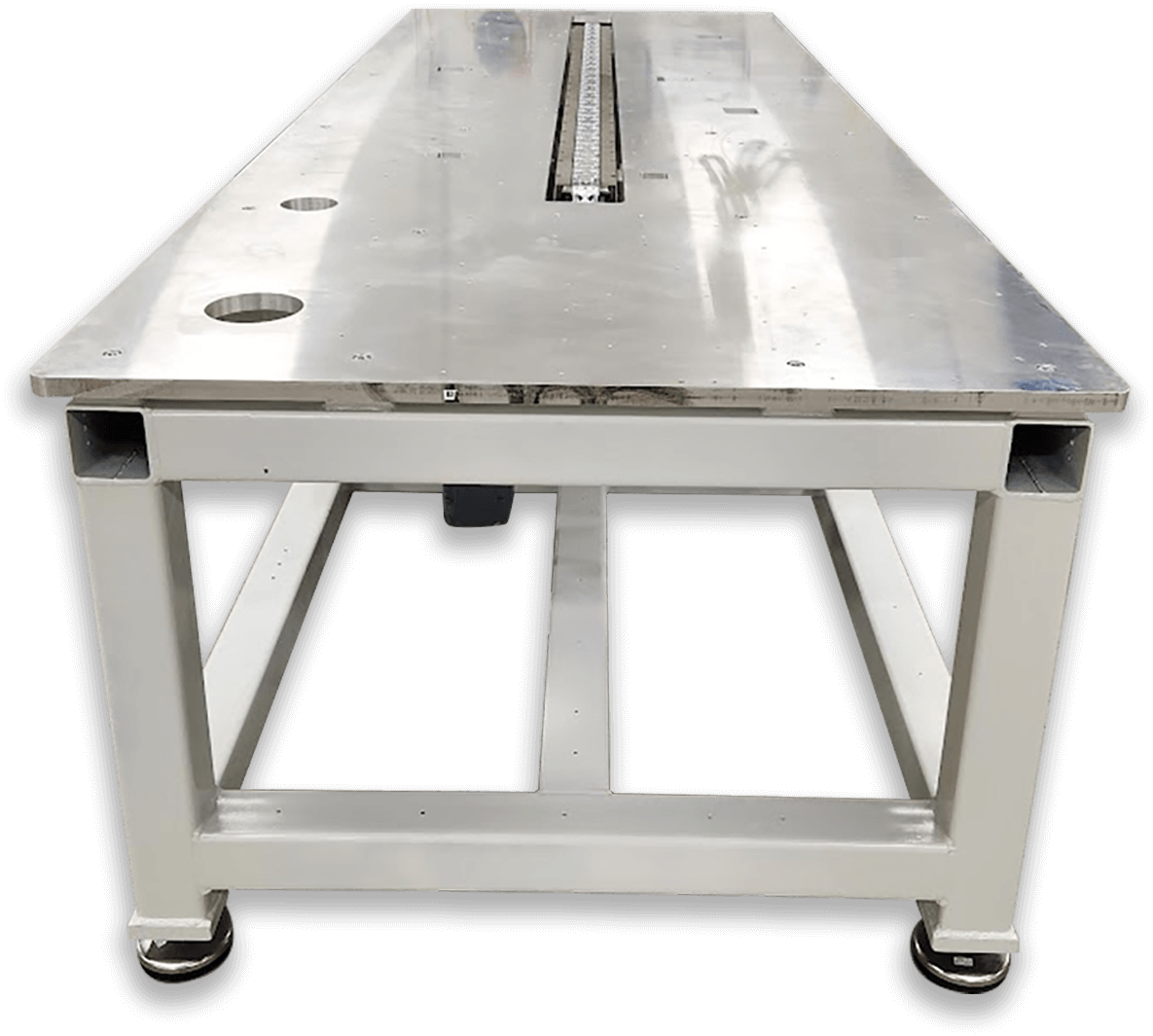
What Is a Robot Transfer Unit?
Robot transfer units (RTUs) expand the working range of industrial robots by adding a linear axis of motion, allowing a robot to travel between multiple workstations or along large parts and assemblies. This expands the robot’s reach in a way that allows manufacturer’s to automate processes without adding multiple stationary robots.
High-precision rack-and-pinion robot transfer systems can achieve backlash as low as 0.02 mm, supporting highly repeatable positioning for applications such as robotic welding, machine tending, polishing, grinding and other automated manufacturing processes.
What Are Robot Transfer Units Used For?
- Automated Machine Tending – Used in CNC machining applications that are fully automated, where the robot can pick up a part a few or several meters away and place it precisely into a machining center. The process would be repeated after the part is fully machined, and the robot can remove the piece and bring it back to a storage rack or hand it off to another robot to be placed into another machining center for further processing. These applications can use either floor-mounted robot transfer units or fully inverted overhead robot transfer units.
- Automated Welding Environments – In these types of applications, the part is stationary, and the robot can traverse back and forth, performing any type of welding operation, from spot welding to MIG welding or laser welding. This is commonly used in the production of large aerospace products, such as large airplanes or tractor trailers. In some of these applications, an automated rotating device is used, such as a weld positioner (sometimes referred to as a trunnion). With the addition of a rotating mechanism, the robot now has two additional axes in the robot transfer unit, enabling the robot to have access to the complete part without any human interaction.
- Polishing or Grinding Applications – Large stainless-steel cylinders used for food storage or production commonly use robot transfer units to automate the production of these products. By utilizing a floor-mounted robot transfer unit and a roller mechanism to turn the part, the robot transfer system can traverse back and forth in coordination with the rolling devices to have complete access to the part and allow the robot to complete the necessary tasks for the polishing or grinding process.
How Does a Robot Transfer Unit Work as a 7th Axis?
Because the robot transfer unit, in most cases, utilizes an additional-axis robot motor, the robot transfer unit becomes an extension of the robot. By using an additional-axis robot motor on the robot transfer unit, an integrator can use the same pendant used to teach the robot to also teach the RTU and perform coordinated moves.
Benefits of Using a Robot Transfer Unit
By extending a robot’s operating range and integrating its movement with the robot controller, robot transfer units provide manufacturers with greater flexibility when automating large or complex processes. Robot transfer units assists a robot to reach multiple workstations with precision and accuracy for a variety of industries such as welding, polishing, painting, or other operations. Robot transfer units can be manufactured for any type or brand of robot. Robot 7th axis also provide these advantages:
- Higher accuracy and better performance: The 7th Axis Slide utilizes a direct drive gear reducer and gear rack that enhances accuracy and performance with fewer components.
- Easy maintenance and accessibility: The robust steel construction allows easy maintenance and accessibility of the robot.
- High mass capability: The oversized linear bearings guideways enable the robot to handle more mass.
- High linear speed: The oversized rack and pinion system allows high linear speed in virtually unlimited travel lengths. The system also increases safety during operations.
- Locally made: Reliable technical support on product inquiry and ongoing maintenance within the USA.
- Space-saving: The 7th Axis transfer unit increases production, thereby reducing the need for additional floor space to accommodate more machinery.
Need to extend your robot’s working range? Explore Motion Index Drives’ Robot Transfer Units for floor-mounted, overhead and custom robotic automation applications.
What is a robot transfer unit?
What is a 7th axis for an industrial robot?
How accurate is a robot transfer unit?
Can a robot transfer unit work with any robot brand?
Can robot transfer units be mounted overhead?
What applications use robot transfer units?