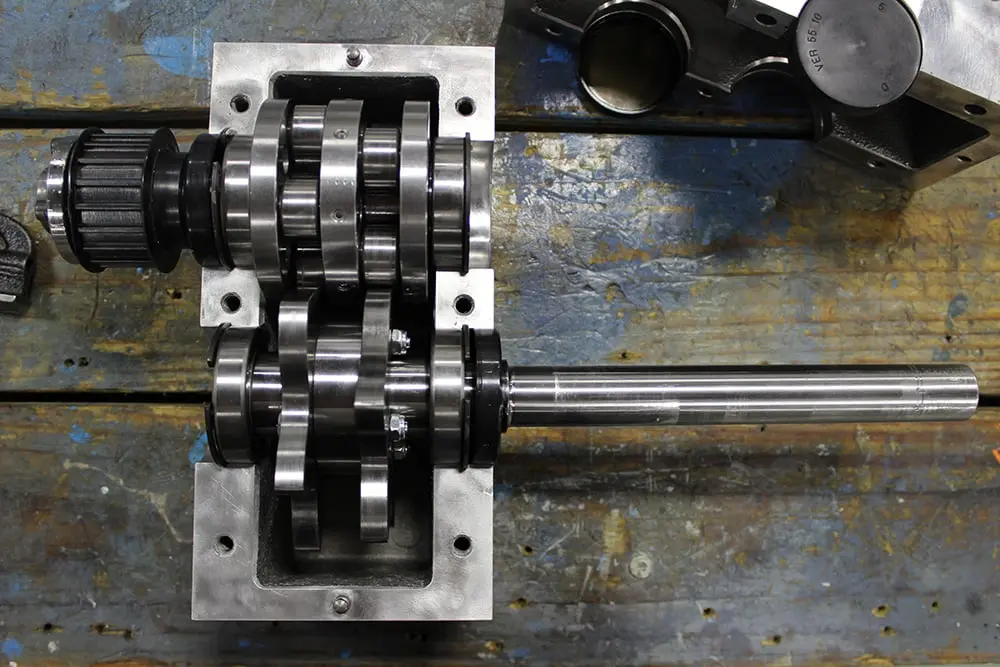


Motion’s complete Single, 3, 4 or 5 Weld Positioning Systems are designed and engineered to provide superior performance in demanding industrial automation environments. Our Dual Trunnion positioning system utilizes our high capacity “zero backlash” TMF rotary turntable for the 180° exchange which creates accuracies of 9 arc seconds and repeatability of 2-3 arc seconds. The extremely high accuracy of the TMF indexer eliminates the need of “Shot Pin” devices that are required from other manufacturers, for high accuracy on their 3-axis (H Positioner) dual trunnion weld positioners.
Single-axis weld positioners rotate a workpiece around one axis, while multi-axis weld positioning systems provide additional movement to orient a part at multiple welding angles. The right configuration depends on part size, weight, weld locations, cycle time, robot access and the number of orientations required during the welding process.
 |
The DR-TR Series utilizes our TR Series servo gear heads for the dual trunnion headstocks, which allows for a 2 second, 180 degree rotation on a load of up to 4000 lbs. per side. Utilizing our TR series servo gear heads with high torque capacity, for the dual trunnion headstocks, allows for a 2.0 second 180 degree rotation on a load of up to 4000 lbs per side and 3 meters between face plates.

The TR series tailstock features a large 90 mm through hole for customers to run utilities to their tooling and fixtures. The fabricated steel structure is manufactured to be extremely rigid to handle the max loads under the fast index times on the exchange of 180 degrees and the 4000 lb per side trunnion loads.

The Multi-Axis Weld Positioning Systems provide a superior accuracy, index time, and flexibility to meet the demands of modern automation systems. As each system is built for our customer’s needs, all dimensions can be adjusted to fit the application requirement. Motion Index Drives offers nine standard models with custom central guarding and custom frame width available.
The DR-TR (H Positioner) dual trunnion weld positioning system was designed to be serviceable while tooling/fixture is mounted and in the robot cell. This eliminates the customer need to re-program robots in the cell or any of the 3-axis on the DR-TR robot positioning system. There are 9 standard models of the DR-TR (H Positioner) dual trunnion weld positioner to choose from. Each of these standard models offers an ergonomically friendly position height. Custom configurations are also available per customers’ requirements.
Learn more about Welding Positioners in our Guide here.
| Consideration | Single Axis | Multi-Axis |
|---|---|---|
| Movement | Rotation around one axis | Multiple rotational axes |
| Best for | Simpler weld paths | Complex weld geometries |
| Robot access | More limited | Greater access to multiple sides |
| Part positioning | Basic | Multiple orientations |
| System complexity | Lower | Higher |
| Typical systems | Headstock/tailstock, rotary | Dual trunnion, H-positioner, multi-axis |
Learn More about the benefits of weld positioners.
What is the difference between a single-axis and multi-axis weld positioner?
Single-axis weld positioners rotate a workpiece around one axis, while multi-axis weld positioning systems provide additional movement to orient a part at multiple welding angles.
How many axes does a robotic weld positioner need?
The number of axes needed depends on the geometry of the workpiece and number of orientations required.
What is a 3-axis weld positioner?
A three axis positioner uses three axes of motion to orient workpices for robotic welding. Multiple axes allow the system to rotate and reposition the part so the robot can reach weld locations that may be difficult or impossible to access with a single-axis positioner.
How much weight can a weld positioner handle?
Weld positioner capacity depends on the system design, workpiece dimensions, center of gravity, tooling, and required motion. Motion Index Drives engineers weld positioning systems around application requirements, with configurations available for both smaller components and heavy industrial assemblies. For example, MID dual-trunnion systems can be configured to support loads up to 4,000 lb per side.
How does a weld positioner improve robotic welding?
A weld positioner moves the workpiece into an optimal orientation for the welding robot, improving access to weld locations and reducing unnecessary robot movement. Proper positioning can help improve weld consistency, cycle time, ergonomics, and overall automation efficiency while allowing the robot to maintain favorable welding angles throughout the process.
Can a weld positioner be integrated into an existing robotic welding cell?
Yes. A weld positioner can be engineered for integration into new or existing robotic welding cells. Important considerations include available floor space, robot reach, payload, tooling, controls, safety requirements, cycle time, and communication with the robot and PLC. Reviewing these requirements early helps ensure the positioner works effectively with the rest of the automation system.
What information is needed to size a weld positioning system?
To properly size a weld positioning system, the application should be evaluated based on the workpiece and fixture weight, part dimensions, center of gravity, required rotational axes and angles, cycle time, welding locations, robot access, tooling requirements, and required accuracy and repeatability. Electrical, pneumatic, hydraulic, or other utilities that must pass through the positioner should also be identified during system design.