

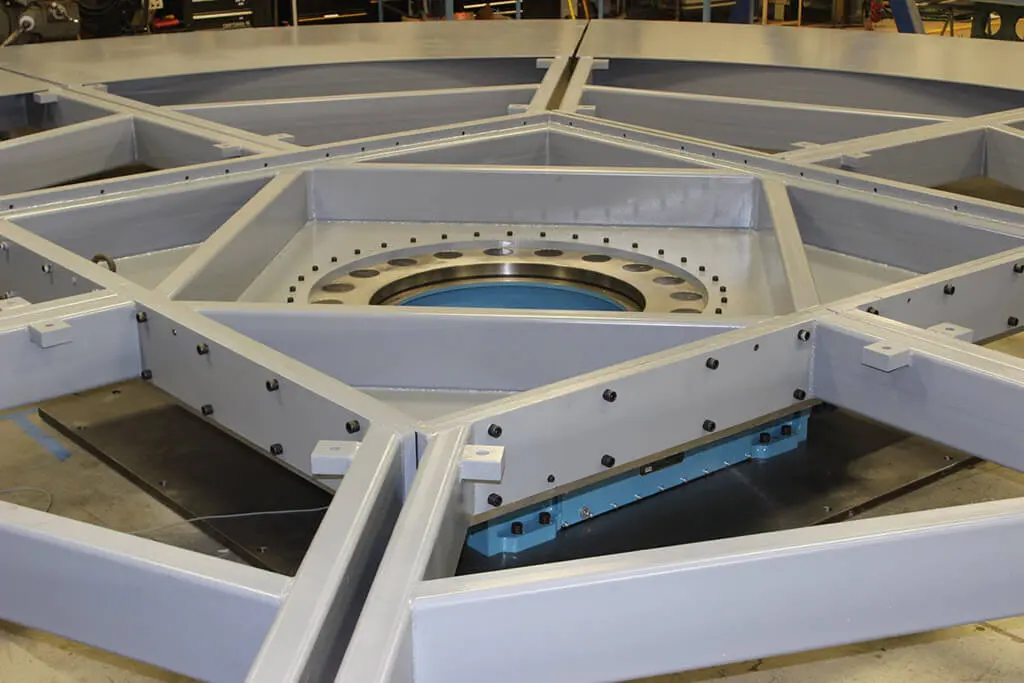
Selecting the right rotary index table involves more than choosing a model based on load capacity. Tooling weight, inertia, cycle time, accuracy, emergency-stop requirements, motor selection, environmental conditions, and machine integration can all affect which index drive is right for an application.
Motion Index Drives, Inc. (MID) has been an engineering-driven indexing solution provider for more than 50 years. Instead of expecting customers to size and select indexing equipment on their own, MID engineers work directly with customers to understand the application, calculate the requirements, and recommend an indexing solution.
MID’s engineering support goes beyond simply selecting an index drive. Our engineers can assist with machine design and integration, giving customers access to decades of automation experience. This can be especially valuable for startups, companies with limited automation experience, or engineering teams working with indexing equipment for the first time.
Engineering support continues throughout the design and build process, as well as during startup and commissioning. If issues come up during integration, MID engineers are available to work through them with the customer. Motion Index Drives provides engineering support throughout the indexing application, including:
The process can begin during the conceptual stage of a project. Based on rough loads, diameters, cycle times, and other basic application information, MID can often specify a unit for budgeting and initial machine design.
As the machine design develops, the sizing and engineering can then be refined around the final application requirements.
Motion Index Drives engineers will ask a series of questions for each application based on simple application specific data from the customer. From this, MID’s engineers will offer a range of products to meet the customers needs.
There is not always just one possible solution. Motion Index Drives offer a range of indexing solutions based on advantages, such as costs, lead time, cycle time (speed), and product expected life.
During the conceptual development stage, MID can also provide budgetary sizing. based on rough loads and diameters, a unit can be specified for budgeting and initial design.
MID engineers typically evaluate:
From this information, the inertia of the application is calculated, and based on this, along with speeds, the index table is sized. The torques from emergency stops are also considered to size the ideal indexers for the application.
Other items MID’s engineers consider are the customers accuracy requirements and if it makes sense to go to a programmable, flexible index drive (encoder-based positioning) or a fixed index drive (solely fixed mechanical cam with dwell positioning).
Any special requirements like offset loading, different or custom index angles, or design constraints are also considered to give our customers a perfect solution to their indexing requirements.


You do not need to have every engineering calculation completed before contacting Motion Index Drives.
To begin evaluating an application, it is helpful to provide:
MID engineers can use this information to begin evaluating the application and determine what additional information may be required.
Another part of the engineering process is determining whether the application is better suited for a fixed or programmable index drive.
A fixed index drive uses a mechanical cam with defined index and dwell positions. This can be an effective solution when the machine repeatedly moves between the same stations and flexible positioning is not required.
A programmable index drive provides flexible, encoder-based positioning and can be used when an application requires multiple positions or changing index locations.
MID engineers evaluate the application requirements rather than automatically recommending one technology over the other.
Accuracy, cycle time, indexing pattern, controls requirements, and the amount of positioning flexibility required all factor into the decision.
Yes. MID helps design the machine other then the index drive, giving customers access to our engineers multi-decades long experience in the automation industry, which can be very beneficial to new startups or companies with little automation experience. We offer support not only in the design phase, but also at startup and during build to help with any issues that may arise.
Support can continue through the design, machine build, startup, and commissioning stages.
Motion Index Drives help size AC motors, or servo motors, providing workbench studies and support the customer 100% to ensure the index drives are commissioned properly. Improper programming can lead to catastrophic failure prematurely, so MID knows how to make sure our customers program important items such as:
The goal is to make sure the index drive is not only sized correctly, but also operated correctly once it is installed in the machine.
Yes. Motion Index Drives can provide engineering support for retrofit and replacement indexing applications.
Motion Index Drives, Inc. helps customers with the after sales requirements. If it is critical spare parts, retrofitted index drives with custom adaptors , and adapting new indexers replacing older controlled indexing systems, Motion Index Drives, Inc. can help!
Information about the existing indexer, mounting arrangement, output height, tooling, load, indexing pattern, cycle time, and controls can help MID engineers determine the appropriate replacement solution.
Motion Index Drives uses a design approval approach, which means custom designs are sent to our customers for review. It is not until both the customer and MID have achieved a design they can agree to does MID start any final detailing or manufacturing.
This approach ensures our customers get the units they need and no exorbitant change in costs are seen by our customers. Our customers get to work DIRECTLY with the engineers to make sure nothing is lost in translation.
This is something that is critical in automation design and development. Following this design approval process, MID then builds and test runs the machine to deliver in the timeframe required.
Whether an application requires a standard rotary index table, a replacement for an existing indexer, a custom indexing angle, or a completely engineered automation system, Motion Index Drives approaches the application as an engineering problem first.
Customers do not need to determine the complete indexing solution before contacting MID.
Provide the application information you have, and Motion Index Drives engineers can evaluate the load, inertia, speed, accuracy, indexing requirements, and machine constraints to help determine the appropriate indexing solution.


