Rotary Index Tables: Complete Guide, Types & Applications
Understanding Radial Systems
Your Guide to Rotary Index Tables
Rotary indexers and indexing systems are designed to precisely position and rotate parts or fixtures or assemblies to predetermined positions during automated manufacturing processes. Rotary table indexes are built to meet your specific demands with high accuracy— such as assembly, welding, machining, inspection, and testing to be performed at different stations around the indexing system.
Motion Index Drives designs and manufactures fixed and programmable cam-driven rotary index tables for industrial automation to maximize consistency across your operation. Systems are engineered around application requirements including load, mass moment of inertia, cycle time, number of stops, accuracy and operating environment. With robust motors and precise mechanisms, they can handle complex positioning without sacrificing results. Investing in reliable indexing tables gives your operation critical efficiency and accuracy where you need it most.
Rotary index tables, also called indexing tables, rotate on a platform or fixture in set increments. These rotations allow for accurate workpiece positioning during sequential tasks. With this positioning and stability, operations can efficiently complete automated manufacturing processes.
How Do Rotary Tables Work?
Rotary tables are usually positioned along a vertical axis or can be mounted horizontally. When mounted horizontally, there can be a tailstock to support the weight of longer workpieces between centers. They rotate in fixed increments, letting multiple processes — like cutting, drilling, assembling or inspecting — happen sequentially without manual repositioning.
Once the workpiece is loaded onto the table, the table rotates to the exact angle needed for each step. The table securely holds the piece through each task until the workpiece is ready.
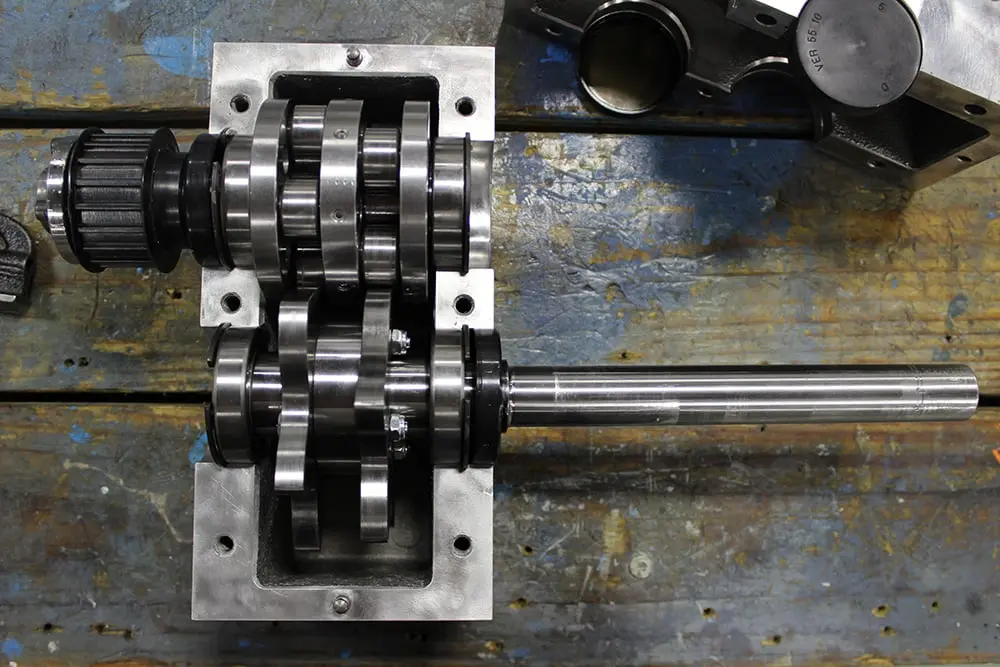
Rotary tables rely on cam-driven or motorized drive systems to ensure smooth, accurate movement. The drive systems use a mathematical motion curve to precisely position pieces as needed. Additionally, the indexing table accounts for load speed, weight and precision requirements to ensure best results.
All of our rotary tables are cam-driven. On small tables, you have the choice of either a worm gear motor or a helical bevel gear motor. For larger rotary tables, a helical bevel gear motor is most commonly used.
A Wide Variety of Rotary Solutions
Indexing Tables Applications in Manufacturing
Rotary Indexing tables are critical to many manufacturing processes. Their ability to precisely position workpieces for consecutive operations makes them essential for machining, assembly, inspection and other areas. Key manufacturing applications for indexing tables include:
Machining
Indexing tables let facilities position components for milling, drilling and cutting. With index tables, the equipment can work on multiple workpiece sides without manual repositioning. This feature is invaluable for machining since it improves speeds and accuracy.
Assembly
Automated assembly lines also use rotary tables. These tables rotate parts, consistently aligning them for bonding, joining or fastening to reduce high-volume production errors.
Inspection & Testing
Facilities can benefit from 360-degree positioning with index tables. Seamless table rotation allows for thorough and efficient inspections or testing.
Labeling
Consumer goods manufacturing also uses rotary tables. They rotate products for packaging and label application, reducing production time.
Device Manufacturing
Medical device manufacturing relies on index tables for assembly and inspection. Tables easily maneuver delicate medical components for precise, repeatable processes.
Welding
Welding also benefits from index tables. Industries like aerospace and automotive require tables for rotating large workpieces. Precise rotation allows for welding in hard-to-reach places without sacrificing quality or safety.
Indexing rotary tables come in several designs. Each option accommodates different manufacturing processes and requirements, meeting your unique needs. Each type offers specific precision, speed and load capacity, from high-speed production lines to heavy-duty machining.
Configurations of Mechanical Indexers
Mechanical indexers, come in various configurations. Each works with different manufacturing needs, so making the right choice is essential. The three main configurations offer excellent benefits, depending on the application.
Fixed Cam-Driven Rotary Index Tables
Fixed cam-driven rotary index tables provide precise, repeatable positioning for high-speed automated manufacturing. A mechanical cam controls the indexing motion, moving the table through a predetermined number of positions, or stops, during each cycle.
The cam profile provides controlled acceleration and deceleration for smooth motion, high accuracy and reliable operation with minimal vibration. Because the index positions and motion are mechanically defined, fixed rotary index tables are ideal for high-volume applications where the indexing sequence does not frequently change.
Common applications include automated assembly, welding, packaging, inspection and automotive manufacturing. Fixed cam-driven rotary index tables are often selected for machines that require fast cycle times, consistent positioning and dependable 24/7 operation.
Programmable Rotary Index Tables
Programmable rotary index tables provide flexible positioning for applications that require multiple index angles, variable motion profiles or frequent production changes. Unlike a fixed indexer with mechanically predetermined stops, a programmable rotary index table uses a servo motor and controls to position the table at different locations as required by the automation system.
Engineers can program index positions, speeds, acceleration and motion sequences around the requirements of the application. This makes programmable rotary index tables well suited for flexible manufacturing, robotic automation, assembly, inspection and applications that process multiple products or part configurations.
Programmable indexing is especially beneficial when manufacturers need the precision and rigidity of a cam-driven indexing system without being limited to a fixed number of stops.
Ring Indexing Drives
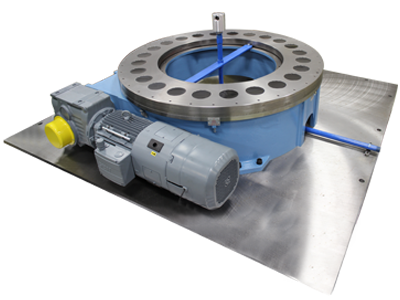
Ring indexing drives are rotary index tables designed with a large open center, providing greater access to the tooling, workpiece and equipment positioned within the indexing system. The open-center design can also provide space for robots, wiring, pneumatic lines and other automation components.
This configuration makes ring index tables particularly useful for automated assembly, welding, inspection and robotic applications where equipment must operate inside or through the center of the indexing table.
Ring indexing drives combine precise, repeatable rotary positioning with a flexible machine layout, making them an effective solution for large tooling systems and applications where accessibility is a primary design consideration.
Trunnion Rotary Index Tables
Trunnion rotary index tables position tooling or workpieces between supports, allowing parts to rotate about a horizontal axis for access to multiple sides of the assembly. They are commonly used when a standard horizontal rotary index table cannot provide sufficient access to the workpiece.
Trunnion indexing systems are well suited for welding, assembly, machining and robotic automation because they allow operations to be performed on multiple sides of a part without manually repositioning it. Depending on the application, trunnion systems can incorporate fixed or programmable indexing and can be engineered around the size, weight, inertia and required positioning of the tooling and workpiece.
For larger or more complex assemblies, a trunnion rotary index table can improve ergonomics, reduce manual handling and give robots or operators better access to the workpiece.
Type
Best For
Motion
Typical Application
Fixed Rotary Index Table
High-volume repetitive automation
Predetermined indexing
Assembly, packaging, automotive
Programmable Rotary Index Table
Flexible automation
Servo-controlled positioning
Robotics, variable production
Ring Index Table
Large open-center applications
Fixed or programmable
Assembly, welding, robotics
Trunnion Index Table
Multi-axis positioning
Horizontal/vertical rotation
Welding, assembly
Right-Angle Index Drive
Compact machine layouts
Fixed indexing
Machinery and automation
Rotary Index Table Drive Technologies
Cam-driven rotary index tables can have significant advantages over other types of rotary index table drive systems, such as gear drives. Cam-driven rotary index tables provide extremely high accuracy because they operate with no backlash. There are several types of commonly used cam-driven rotary index table systems, and each is best for a specific application:
Barrel Cam-driven
Barrel cams use a cylindrical cam to maximize strength. Indexers with barrel cams deliver superior strength without increasing their size.
Flat/disc Cam-driven
These devices feature a flat or disc-shaped cam. Choose flat or disc cams to save space while operating at high speeds with long dwell periods.
Globoidal Cam-driven
Globoidal cams have grooves with tapered walls. This design accommodates cam followers fixed to an output shaft in a “star” configuration.
Selecting a Rotary Indexing Table System
There are important factors to consider when selecting a rotary index table system. In principle, it may seem relatively simple to rotate a component and stop periodically at precise angles. In practice, however, it can become a surprisingly difficult challenge to design and build machines that will do this precisely and reliably over the life span expected of modern manufacturing machinery.
Mass Moment of Inertia
The number one factor when rotating mass is determining the mass moment of inertia. Knowing the mass moment of inertia is critical for rotary index table sizing. Once you have this figure, professionals can size the index table for the necessary speed.
Piece Size
Another important aspect is the size of the piece being moved. How big is it, and how heavy is it? Size is an obvious constraint, as you need a rotary index table that is large enough for the piece intended. In order for a rotary index table to operate effectively and not cause internal damage, it needs to accelerate and decelerate at proper speeds.
Precision
How precise does your application need to be? Some applications allow for fairly loose individual stop positions, such as within +/- ¼” and other applications where repeatable positioning within thousands of an inch is necessary. More precise requirements mean selecting an index table that can meet those demands.
Tailored Solutions for Your Unique Needs
How Do You Choose a Rotary Index Table?
When selecting an indexing table mechanism, it is important to be able to specify the following:
Accuracy
Backlash
Mass moment of inertia
Acceleration and deceleration
Speed
Environment
Understanding each of the points will ensure you get the index table you need. Work with our team to find an existing model or custom solution that fits your application.
Rotary Indexers can be configured in a near–infinite number of ways to meet the needs of specific applications. Choose custom components to ensure a rotary index table that meets your specific demands.
Common components / accessories that we are asked to provide include:
Machine Bases
Slip Rings / Rotary Unions
Top Dials
Tooling Frames
Controls
Robot Integration
Custom Coatings
Motors and Reducers
Trunnion Riser Weldments
Mechanical Safety Lockouts
Explosion Proof Systems
Reliable Table Manufacturing and Installation
Rotary Index Table Commissioning
Your manufacturer should offer trained service technicians who are capable of complete testing of both the rotary tables and control systems, including loading, parameters and tuning. Learn what you need to consider when sizing your rotary index table. Your best option is often to have a pre-programmed VFD panel which can significantly reduce your risk when going through commissioning and start-up.
Getting to a reliable and productive rotary index table installation requires careful application engineering, component selection and integration, and customization to meet specific factors such as the operating environment and proper commissioning. It is important that you discuss commissioning with your rotary index table provider so that you meet the intended functionality and reliability and so that there are no excuses when it comes to any troubleshooting that may occur.
Proper maintenance is critical for protecting rotary index table performance. These machines are integral to your automated processes — downtime can lead to costly delays. Rotary index table failure is often caused by stopping out of position due to lack of maintenance.
While you can perform basic tasks like keeping the table clean and monitoring for unusual sounds, professionals should handle maintenance needs. Index tables contain sensitive components that improper handling could damage.
Professional maintenance includes:
Lubrication: Rotary index tables use gears and bearings to provide precision. These components must be kept lubricated to prevent wear and ensure smooth operation. Poor lubrication can lead to overheating or failure. Lubricate is recommended to prevent downtime.
Alignment checks: Over time, components may shift and wear down. This wear can lead to misalignment, affecting performance. A technician can ensure your table’s indexing accuracy remains within acceptable tolerances. This maintenance task is essential for ensuring precision during operation.
Motor inspections: Motor inspections are also important for rotary index tables. Their motors can wear down, leading to malfunctions or larger issues. Professionals can detect early malfunction signs and assess motor conditions to protect your device. They will assess motors, cams and other components to address problems before they lead to downtime.
Every rotary index table should have a regular health assessment to prevent issues. Technicians will examine the table for complications, documenting the device’s health. Assessments involve a detailed look at all components, cataloging issues and wear.
Once this is done, technicians can advise you on necessary repairs and next steps. If you are experiencing problems and need help troubleshooting, health assessments are critical. Additionally, schedule regular inspections to protect the device’s life span and ensure it remains efficient.
If you need any technical or service assistance, please contact us for 24-hour support. We will arrive on-site to diagnose and resolve your rotary table issue. Let our expert technicians help you reduce downtime and protect your investment.
Your Expert Partner for Indexing Operations
Selecting a Rotary Indexing Table Manufacturer
Rotary index tables are essential for ensuring precision, production scale, reliability and longevity. Without these qualities, your manufacturing workflows could see reduced efficiency and productivity. Motion Index Drives is your partner in selecting and maintaining the best index table for your applications.
That is why it is important that you select a partner with a proven track record of delivering the right machine for the application, producing machinery using the highest quality components and being there to have your back should things not go as you planned.
Features that can be important in your rotary index table include:
Low friction internal components: Lower friction index drives can require as little as one-third the amperage to operate while producing greater torque.
Flame-hardened cams and cam followers: Flame-hardened cams and cam followers can withstand forces that cause less robust components to fail prematurely.
Choose an ISO 9001 Certified partner and embrace a culture of continuous improvement. To learn a bit about what we feel makes Motion Index Drives a uniquely valuable rotary index table partner, you can explore here! Contact us online to learn more about our services or request assistance.